

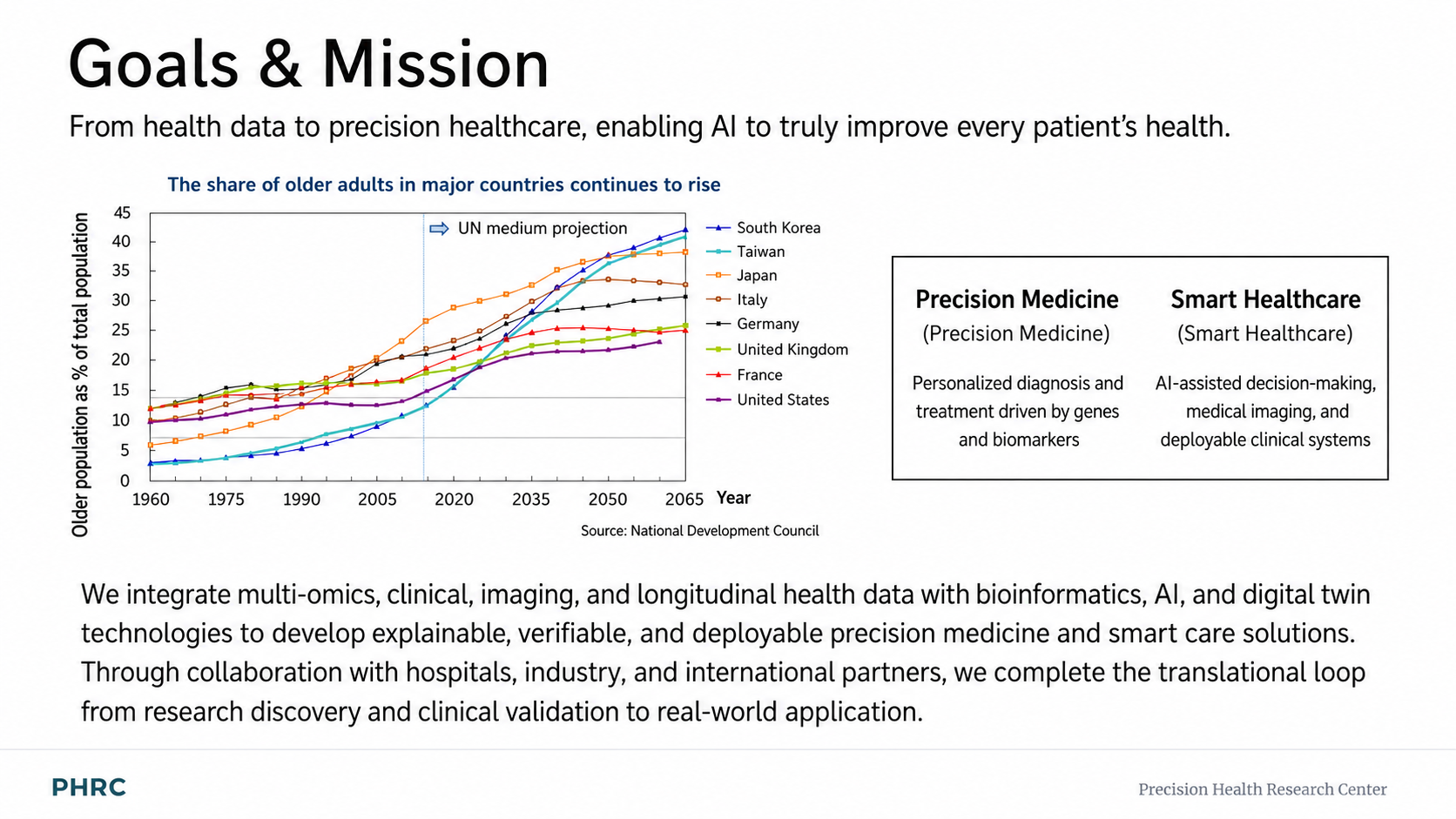
[Taichung, August 20, 2026] Asia University’s Precision Health Research Center is reviewing a decade of progress from 2016 to 2026 and advancing its mission: “From health data to precision healthcare, enabling AI to truly improve every patient’s health.” By integrating multi-omics, clinical, imaging, and longitudinal health data with bioinformatics, artificial intelligence, and digital twin technologies, the center develops precision medicine and smart-care solutions that are explainable, verifiable, and deployable. Partnerships with hospitals, industry, and international institutions support a complete translational pathway from research discovery and clinical validation to real-world application.
Founded in 2016 and renamed from the Precision Medicine Research Center to the Precision Health Research Center in October 2020, the center has expanded its scope from precision diagnosis and treatment to disease prevention, health promotion, and personalized health management. Its work now spans three major areas: precision medicine, smart healthcare, and precision nutrition. From 2016 to 2026, the center carried out 54 projects funded by Taiwan’s National Science and Technology Council or through industry-academia collaboration. By 2025, it had accumulated more than 30 patent achievements and more than 500 international journal publications in areas including medical imaging AI, dialysis care, gait analysis, federated learning, and precision risk assessment for kidney disease.
Kidney care is among the center’s most prominent translational achievements. The PPTP kidney-care initiative combines medical big data, AI, and blockchain technology under a four-year NT$26.7 million grant from the National Science and Technology Council, establishing an intelligent blockchain platform focused on nephrology and hemodialysis care. The project also entered clinical trials with SEHA Kidney Care in Abu Dhabi and was presented at MEDICA in Germany. The center’s cardiothoracic ratio estimation system received a Class II medical device license from Taiwan’s Food and Drug Administration. Its intelligent home-hemodialysis monitoring and early-warning system and its cloud platform for AI-assisted detection and remote monitoring of peritoneal dialysis catheter exit-site infection won the 21st and 22nd National Innovation Awards, respectively.
In response to population aging and workforce pressures in healthcare, the center is expanding AI applications across clinical and care workflows. Its projects include multimodal prediction of emergency-department disposition, atrial-fibrillation risk detection using non-invasive blood-pressure signals, peritoneal dialysis and chronic kidney disease nutrition management, indoor navigation for smart hospitals, and medical AI agents that combine large language models, retrieval-augmented generation, and multi-agent collaboration. The team is also developing intelligent assistive robots, dual-arm mobile robots for supply delivery, fall-prevention alerts, and exoskeleton rehabilitation technologies, moving AI beyond analytics to support decision-making, monitoring, care, and routine operations in healthcare settings.
The center is also extending precision health into pediatrics and drug discovery. By combining single-cell analysis, tumor databases, medical imaging, and multimodal models, researchers are studying refractory and recurrent pediatric brain tumors as well as asthma risk among children with adenoid hypertrophy. The team is also using NVIDIA BioNeMo and high-performance computing to support drug design and virtual screening across 170,000 compounds from traditional Chinese medicine, opening new translational pathways between traditional medicine and modern precision medicine.
Looking toward the next 20 years, the Precision Health Research Center will continue to build around Asia University while deepening collaboration with Asia University Hospital, China Medical University Hospital, industry partners, and international research institutions. Its priorities are to strengthen local clinical validation pipelines, cultivate interdisciplinary health-informatics talent, and expand Asia-wide research networks and data alliances. The next phase will also focus on commercializing research outcomes and preparing spin-off ventures so that precision health technologies can reach hospital bedsides, homes, and communities.